
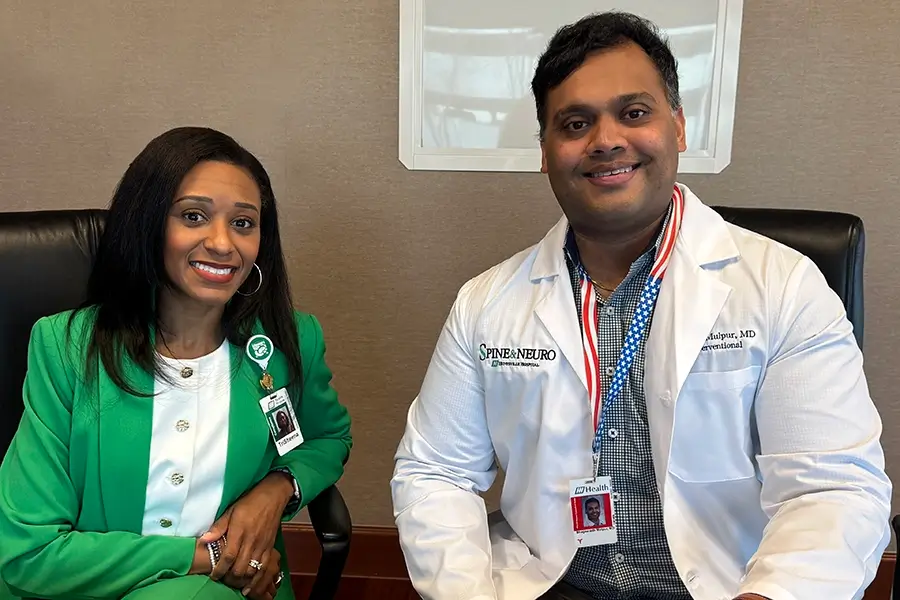
Like many Huntsville Hospital employees, Tri’Sheena Stokes can tell you the signs of a stroke.
Confusion.
Blurry vision.
Arm weakness.
Face drooping.
Headache.
But when she began experiencing those symptoms herself while out shopping, it never dawned on Tri’Sheena that she might be having a stroke. Not at age 39.
“It was easy to dismiss because of my age,” she said. “So I just pushed through with my day. Fortunately, I’m still alive to be able to say to anyone under 40: ‘Listen to your body; don’t ignore the symptoms.’”
March 6, 2025, started like any other Thursday for Tri’Sheena, a busy mom who works as a corporate compliance specialist at Huntsville Hospital. At lunchtime, she drove to Parkway Place Mall in Huntsville to do a little shopping. She was in the cosmetics section at Dillard’s when she dropped her phone.
She bent down but had trouble picking the phone up off the floor. She also stumbled a couple times. Store employees noticed her struggling and came over to see if she needed help.
Tri’Sheena figured she was just shaky from not having eaten lunch and drove to Zaxby’s in Jones Valley. Waiting in the drive-through line, she couldn’t remember the code to unlock her phone.
And when she tried to take a sip from a water bottle, her mouth wouldn’t cooperate – the water dribbled down her chin onto her shirt.
Tri’Sheena drove home and took a multi-vitamin, thinking it might make her feel better. She was tired, but sleep wasn’t an option. She was days away from completing her doctoral degree in health care administration through Morehouse School of Medicine and needed to prepare for an important zoom call that evening with one of her professors in Atlanta.
When her husband, Frank, got home, he noticed her face drooping and said so.
“You mean like a stroke?” Tri’Sheena replied jokingly.
She went to bed that night with a splitting headache.
When she woke the next morning, head still pounding, Tri’Sheena decided to call a cousin in Georgia who’s married to an Emergency Department physician. After hearing her symptoms, the doctor insisted that Tri’Sheena get to a hospital – right away.
Dr. Bhageeradh Mulpur, an interventional neurologist and stroke expert at Huntsville Hospital Spine & Neuro who treated Tri’Sheena, said it was not immediately clear what caused her to have a stroke at such a young age.
It took an angiogram – which traces an injected dye through the blood vessels – to finally reveal the culprit: a dissected, or partially torn, artery on the right side of her brain. A small blood clot that formed around the tear had broken loose and become wedged in the artery, interrupting the normal flow of blood.
The diagnosis wasn’t entirely surprising since Tri’Sheena has a family history of blood clots. Her father died suddenly at age 53 from a pulmonary embolism caused by a blood clot that traveled from a vein in his leg to his lungs.
Dr. Mulpur said strokes triggered by arterial dissection in the brain are exceedingly rare. “It’s a one-in-a-million type of event,” he said.
Fortunately, Tri’Sheena’s clot was only partially blocking the artery and so did not require surgery. Dr. Mulpur put her on two blood thinners to help stabilize the damaged artery and prevent new clots from forming.
Today, a year after her stroke, Tri’Sheena is using March’s National Blood Clot Awareness Month to remind other young adults that strokes can happen at any age. She also recently co-founded a nonprofit to help Alabama residents understand the risk factors and dangers of blood clots. The organization is named for Marcus Wayne Colquitt, an Opelika man who, like her own father, died from a pulmonary embolism.
“Our bodies will tell us when something’s wrong, so pay attention,” Tri’Sheena said. “I thought I was just being clumsy that day, but I put myself and a lot of other people at risk by dismissing the signs.”
“It’s only by the grace of God that I made it.”

